The best-known collection chamois in France, a species endemic to France. As early as 1937, Doctor Marcel COUTURIER, defending his thesis entitled, “Contribution to the natural history of the chamois”, spoke of the CHARTREUSE chamois as a specific sub-species. Among the appendices to his thesis, he wrote a monograph in 1938 entitled “The Chamois”.
He was the first scientist to highlight the significant differences between the Chartreuse chamois and the Alpine chamois, namely:
- a) Shorter limbs,
- b) Higher average weight,
- c) In winter, the coat is darker, called jet black,
- d) “Horns with a transversal flattening from the start of the curve of the hook up to a few centimeters from the apex”.
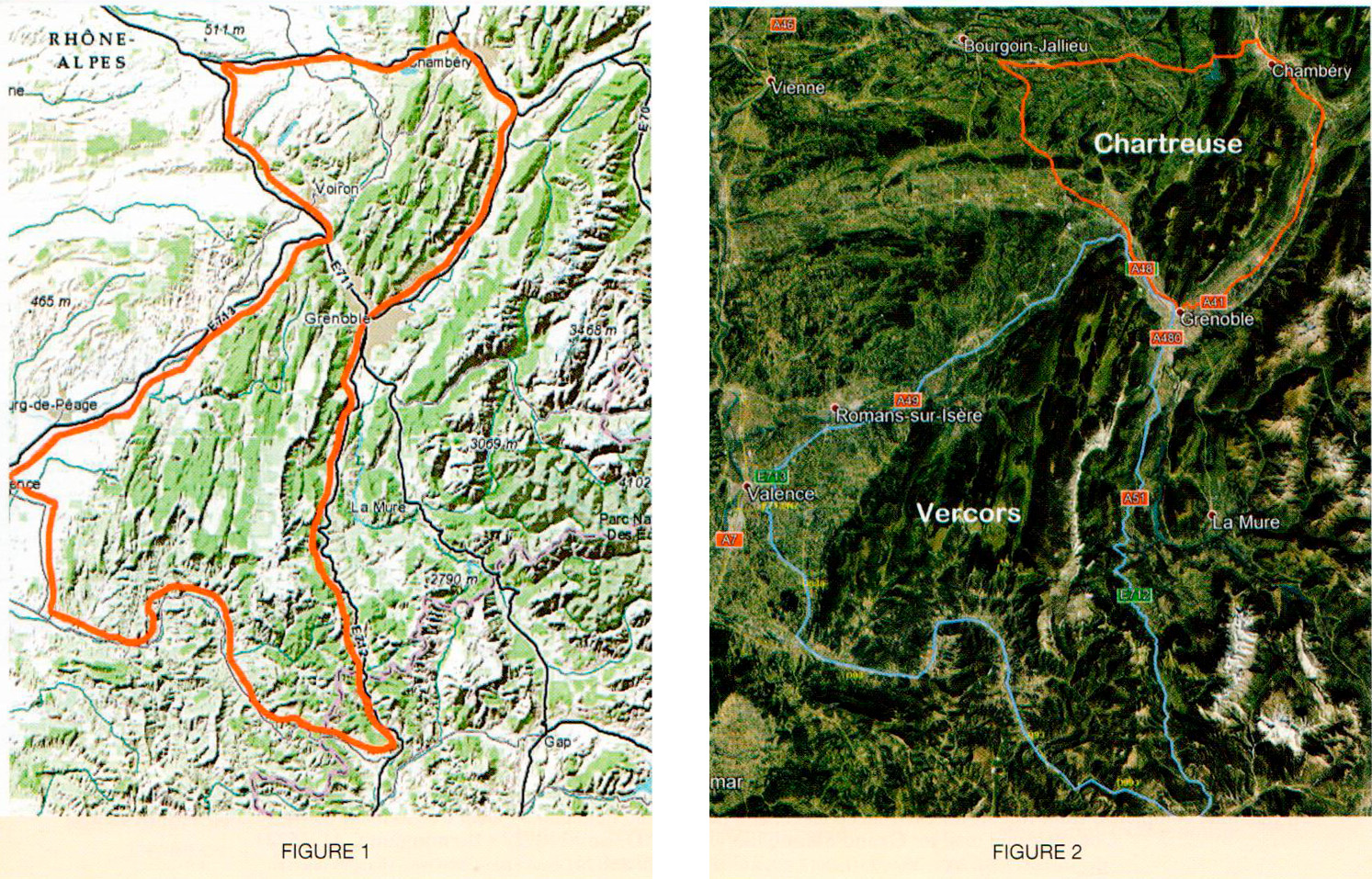
The GSCO Slam Quest, in its spring review 2020, number 192, pages 45 & 46, published an article defining the modern geographical area for the appellation of this particular type of chamois. That area has a triangular form, the boundaries of which are as follows:
- a) to the south of the A43 motorway (section from La Tour du Pin to Chambéry),
- b) to the north-east of the A48 motorway (section from La Tour du Pin to Grenoble),
- c) to the west of the A41 motorway (section from Grenoble to Chambéry).
Summary / key points:
Game that’s 100% natural, access to selected territories, ALL OUR HUNTS HAVE TAKEN PLACE ON THE FIRST HUNTING DAY, the experience of the guides from HUNT IN FRANCE, our local partner who goes out on initial tracking expeditions;
Strict respect of the appellation area of the GSCO (USA) and of the KGO (Russia);
Upon request by collectors, you leave with a certificate of origin;
Firing distances from 80 to 250 meters;
We leave for the whole day, with packed meals;
Average gradient: 500m
For collectors, near to the Vercors.
Natural history:
French name: chamois
Latin name: Rupicapra rupicapra cartusiana
Biometry: muzzle-tail: (short tail) 110/130 cm for the males compared with 100/120cm for the females; withers: from 75 to 80 cm for the males and from 70 to 75 cm for the females; weight: from 2.5 kg at birth to nearly 50 kg for an adult he-goat.
Reproduction: rut from mid-October to the end of November or the beginning of December.
Parturition: May to June, gestation time: 23 weeks
Géolocalisation